
If you've ever answered "zero" when quickly reading the expression 10 − 10 × 10 + 10, you're not alone. This seemingly simple calculation hides a very common trap, even for adults. The culprit: the order of operations. Let's review the basics together, so you don't make the same mistake again.
This calculation is confusing

Let's look at the expression:
10 − 10 × 10 + 10
At first glance, it seems easy. However, many people add or subtract incorrectly, which gives an incorrect result. And if you thought you were getting 0 , you've fallen into the trap. The correct answer is… −80 .
The key: priority rules (PEMDAS or BODMAS)
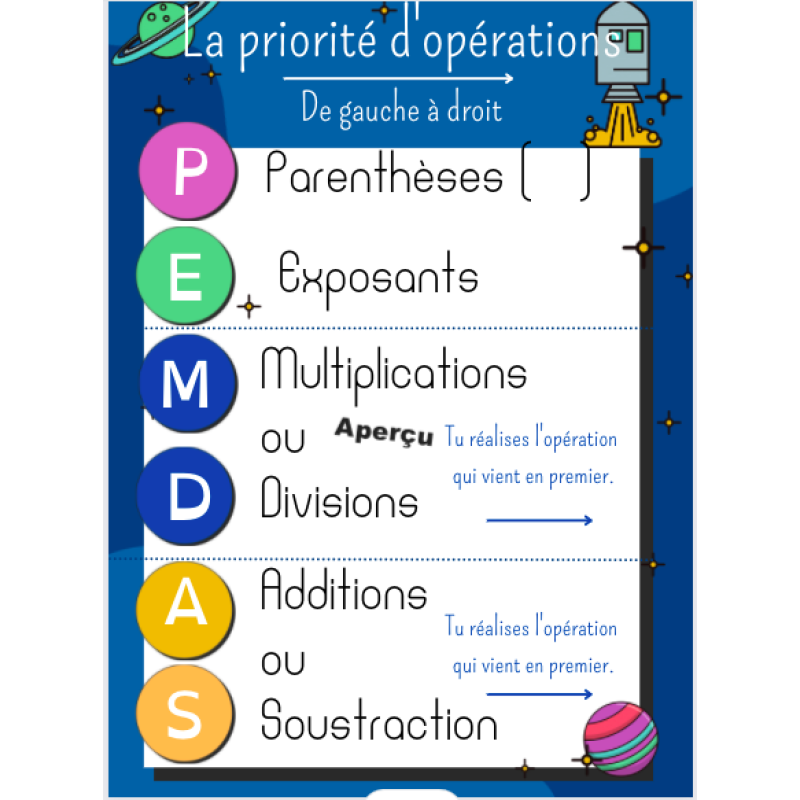
These acronyms, taught in middle school, serve as a reminder of the order to be followed:
- P stands for Parentheses
- E for Exhibitors
- MD for Multiplication and Division
- AS stands for Addition and Subtraction
In French, we often talk about BODMAS, but the principle is the same: multiplication and division come before addition and subtraction, even if they appear later in the calculation.
Step-by-step solution
Let's revisit the expression:
10 − 10 × 10 + 10
We begin with multiplication:
10 × 10 = 100
The expression then becomes:
10 − 100 + 10
Next, we calculate from left to right:
10 − 100 = −90
−90 + 10 = −80
Final result: -80
Why do we make mistakes so often?
Because we tend to read and solve calculations in order, without applying the order of operations. Out of habit or for the sake of speed, mistakes happen quickly. Many people think that all the operations follow each other "as they appear," when this is not the case.
How to avoid making a mistake?
Here are some practical tips:
- Always identify multiplications and divisions first.
- Use parentheses if you are unsure. Example: (10 − 10) × (10 + 10) does not give the same result at all.
- Read your calculation slowly or aloud.
- Practice with other short expressions to automate the reflex.
A little challenge to practice?
Solve this expression:
20 + 5 × 2 − 10
Hint: Multiplication comes before addition and subtraction. The answer is not 40 …
Maths is like a recipe: you just have to follow the order of the steps for the result to be correct.


.webp)


.webp)

0 Comments:
Post a Comment