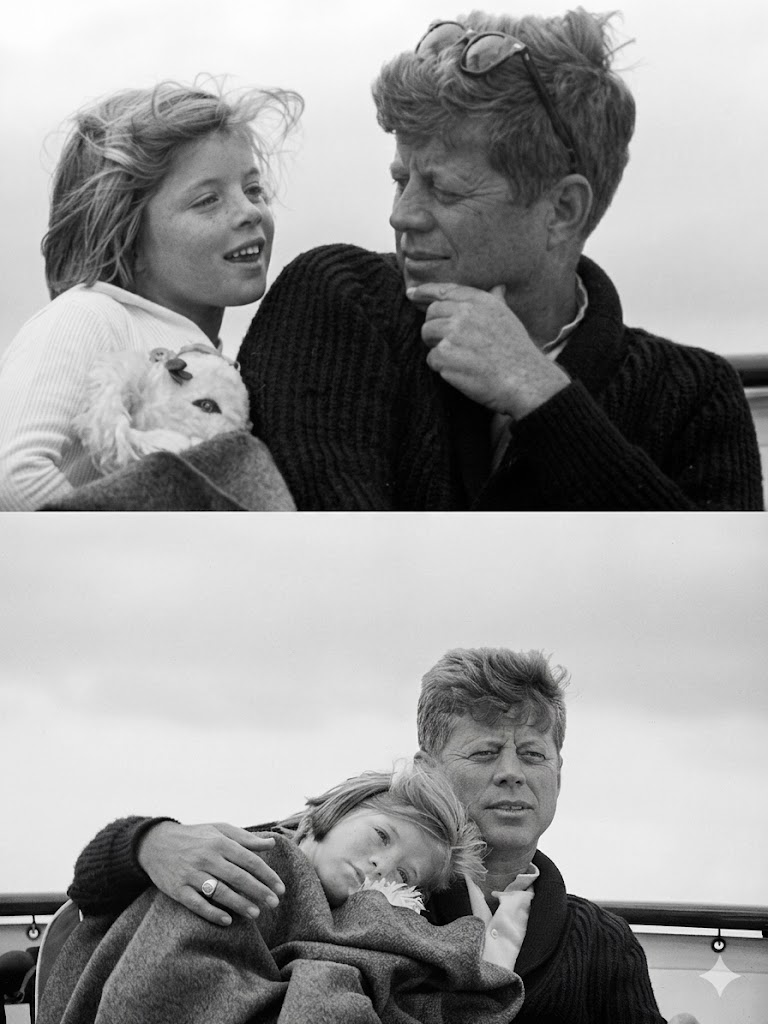
The most powerful president in the world would lean over the railing of a ship and point to the water. “Look, Caroline, there they are again.” She never saw them. But she believed him. Until one day, years after his death, she discovered the truth. There is one memory that Caroline Kennedy carried with her for more than 60 years, a memory she shared publicly only once, in a quiet video released one spring afternoon in 2017. And it is so simple and so tender that it stops you in your tracks the moment you hear it. She said that every time they went out on the water aboard the Honey Fitz, her father would lean over the railing very seriously and point to the waves, telling her about the great white shark and the purple shark that always followed the ship. She said she could never see them completely, even when she tried, but she believed him wholeheartedly because he described them in such precise and convincing detail. And then, with absolute presidential authority, he would announce that these sharks had a well-known penchant for eating socks, and would have their socks thrown overboard into the Atlantic, while Caroline watched with the certainty that she was witnessing something real. She said she loved it every time. On August 25, 1963, photographer Cecil Stoughton was aboard the Honey Fitz off Hyannis Port when he took what would later be described as one of the most moving photographs of the Kennedy presidency: a father and his six-year-old daughter, sitting together on the deck of a boat named after her great-grandfather, the sun shining on the water, the whole summer stretching out around them. None of us knew it was one of the last summers they would spend together. Caroline was six years old when her father died. Six years and two months. She was still just a child. She still believed in colorful sharks when she was forced to wear black and walk behind a coffin. For decades, she treasured that memory. She didn't talk about the sharks in interviews. She didn't write about it in her books. It was too personal. Too fragile. Until 2017. That year, Caroline filmed a video for a project about her father's memory. She didn't talk about politics. She didn't talk about the Cold War or the Bay of Pigs. She talked about socks. About sharks. About afternoons at sea. And at the end of the video, she said something that left millions of people speechless, their eyes welling up. She said she never saw sharks again after her father died. But she also said that during the hardest days of her life—when she lost her brother, when she faced illness, when life turned dark—she would look out to sea and search. She would search for a white patch. A purple patch. And even if she never found them, the simple act of searching helped her move forward. But what Caroline never mentioned in that video—what she kept to herself for more than 50 years—was what happened one stormy night at Cape Cod, long after her father had died. A night when the sea was raging and she, now an adult, stood alone on the shore and saw something that brought her to her knees on the wet sand. Something no scientist could explain. Something that forced her to revisit every memory she had of sharks from her childhood. What did Caroline Kennedy see that night at sea? And how could a story invented by her father 60 years ago manifest itself in a way that even she couldn't believe? 👇 The second part of this story—the mystery Caroline never revealed in the 2017 video—is in the comments. Don't miss it.
The great white shark and the purple shark: the story invented by John F. Kennedy for his daughter, which she never forgot.
Aboard the family boat, a father transforms a simple outing at sea into an unforgettable memory thanks to a story as strange as it is heartwarming. Between an imaginary great white shark, a purple shark, and socks thrown into the water, a little girl discovers a world where politics disappears, giving way to the magic of childhood. This now-legendary anecdote tells above all of a father's love for his daughter.
According to Caroline Kennedy's account, these moments spent on President John F. Kennedy's family boat were much more than simple outings. For his daughter, each trip became an imaginary journey where the adult world completely faded away. In this universe, two invented sea creatures came to life: a great white shark and a purple shark, guiding the boat through the waves and fueling the wonder of a child.
Childhood memories shaped by the imagination
This memory, recounted years later by Caroline Kennedy, also shows how childhood can be shaped by small, seemingly insignificant rituals that become major emotional touchstones. The boat, the laughter, the wind, and the invented stories formed a unique cocoon, far removed from official protocols and public obligations. In these suspended moments, the sea became a theater ofimaginationwhere each wave could conceal a new adventure.
This story continues to be shared because it illustrates how childhood memories are often built around simple yet striking details. A voice, a gesture, an invented story can sometimes remain etched in our memories for a lifetime, far more so than officially significant events.
The role of a father between politics and imagination
In a time marked by heavy political responsibilities, John F. Kennedy found in these family moments a precious escape. Far from international crises and historic decisions, he simply became an attentive and creative father again. By inventing whimsical and tender stories, he offered his daughter a space of emotional security, where even socks thrown overboard became a playful game shared with the adults on board.
This way of telling stories wasn't just a game. It also reflected a desire to protect her child's innocence from the pressures of the outside world. In an intense political climate, marked by media pressure and national responsibilities, these moments became a respite. Imagination then served as a bridge between reality and the gentleness of childhood.
In this context, the story of the sharks becomes primarily a metaphor for the relationship between a parent and child. It shows how imaginationcantransform the perception of reality and offer a space of emotional security, even during periods of intense pressure. This type of memory helps strengthen family bonds over the long term.
Why does this legend continue to resonate today?
Even today, this anecdote continues to circulate because it goes far beyond a simple family story. It illustrates the power ofimaginationin the construction of childhood memories and how a parent can transform an ordinary moment into a defining memory. For many, it serves as a reminder that behind public figures lie human beings capable of gentleness, creativity, and genuine love, far removed from the spotlight and official pronouncements.
Over time, this story has taken on an almost symbolic dimension. It has become a reflection of a father-daughter relationship marked by tenderness and complicity. In a world where political figures are often perceived through their historical decisions, this type of memory reminds us of their humanity. It is precisely this intimate dimension that continues to move entire generations.
Conclusion
This story is a reminder that a simple story shared between a father and his daughter can sometimes leave a more lasting impression than any official speech.
I did it again, read one of these stories that tags you and drags you, like an accident behind a car, damaging you, but, not quite killing you, and then, bam, there's no ending ! Unconscionable




.webp)


.webp)


I did it again, read one of these stories that tags you and drags you, like an accident behind a car, damaging you, but, not quite killing you, and then, bam, there's no ending ! Unconscionable
ReplyDelete