.webp)
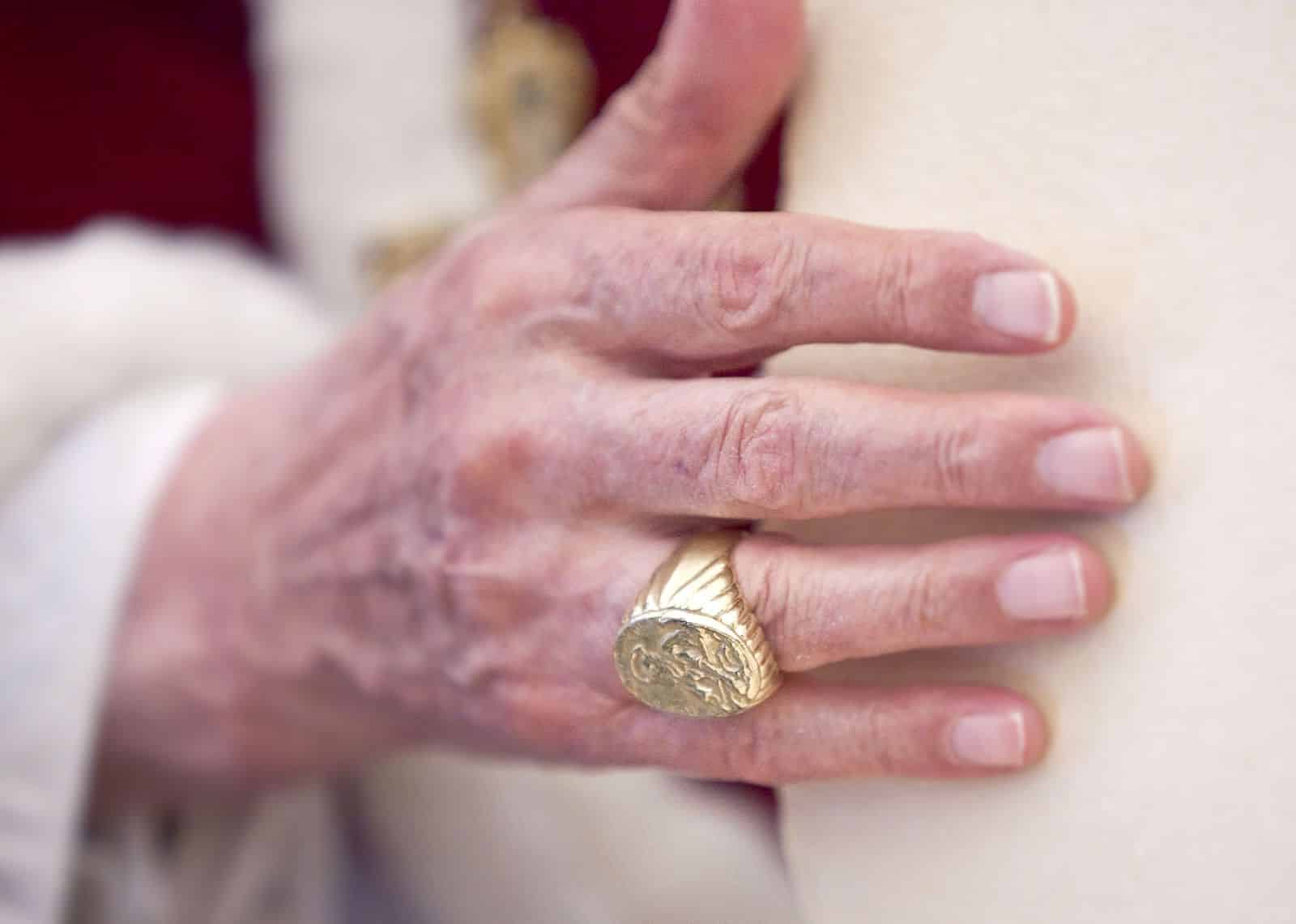
A little-known Vatican custom dictates that the papal ring, a symbol of the Pope's spiritual authority, is systematically broken upon his death. This ancient ritual, rich in meaning, symbolically marks the transition to a new era for the Catholic Church.
The death of Pope Francis: a historic moment for the Church
On April 21 , the Catholic world was shaken by the news of the death of Pope Francis, who passed away peacefully at the age of 88. The cause of death was a stroke that led to irreversible heart failure . Cardinal Kevin Farrell , serving as Camerlengo , officially announced: "This morning at 7:35 a.m., the Holy Father entered his heavenly abode."
After a twelve-year reign characterized by his modesty and devotion to the poorest, Francis leaves behind a considerable spiritual legacy .
The papal ring: an emblem of power steeped in history

Worn on the pontiff's right ring finger, the Fisherman's Ring embodies Saint Peter , the humble fisherman who became the first head of the Catholic Church . Since the Middle Ages, this precious object has also been used to seal official Vatican documents .
A centuries-old tradition dictates that this ring be destroyed immediately after the Pope's death . This practice aims to prevent any attempt at fraud during the transitional period before the election of the new pontiff.
This can be compared to the revocation of a digital certificate : an essential security measure to protect the integrity of the institution.
The ritual of destruction: a ceremony laden with symbolism

The protocol is strictly codified. In the presence of Vatican dignitaries , the ring undergoes either a clean break or irreversible damage . For Francis, the procedure consisted of a hammer blow administered by Cardinal Farrell , thus marking the object indelibly.
This solemn gesture marks the end of a reign and paves the way for the election of the next pope during the conclave.
A pontiff breaking with ostentatious traditions

True to his reputation for simplicity, Francis opted for a minimalist version of the papal ring. Rather than a solid gold piece like his predecessors, he chose a silver-plated model , reusing an old ring that had belonged to Pasquale Macchi , a collaborator of Pope Paul VI.
Contrary to custom, he only wore this insignia during major celebrations . In everyday life, he preferred a simple silver ring , reflecting his desire to break with the traditional pomp of the papacy.
This approach was also evident in his interactions: in 2019 , he delicately prevented faithful from kissing his hand , not out of contempt but out of health concern and to remind people that true piety does not reside in protocol gestures .
The little-known rituals that accompany the death of a pope
The death of a pontiff triggers a series of ancestral rituals . His apartments – in the case of Francis, the modest Domus Sanctae Marthae – are sealed with wax to preserve their integrity.
His will, if he has one, is read before the College of Cardinals. A period of official mourning precedes the funeral, scheduled between April 24 and 27 .
In keeping with his austere lifestyle, François had requested a simple funeral, foregoing the traditional triple coffin. A wooden coffin lined with zinc will suffice to hold his remains.
The lasting legacy of a people's pope
The destruction of the papal ring symbolically closes an important chapter in the history of the Church, but the essence of its message endures: humility, empathy and constant concern for the marginalized .
With this ritual gesture, the Catholic institution turns a memorable page while already preparing for the next one .


.webp)


.webp)

0 Comments:
Post a Comment