.webp)
Is your lawn losing its vigor and developing discolored patches? This damage often indicates the presence of voracious grubs nesting in the soil. Discover a natural and proven solution to protect your garden in no time.
Where do these larvae that are ravaging your lawn come from?
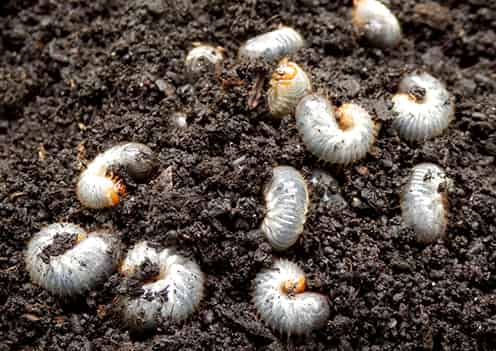
They work secretly, underground, and voraciously : beetle larvae love the roots of your lawn. Hidden in the soil, they work discreetly to weaken your grass, leaving behind discolored, dried-out, or sparse patches . To make matters worse, these areas become magnets for burrowing animals like blackbirds, hedgehogs, or even badgers , which come to dig up the soil in search of food.
These small, hook-shaped, arched creatures appear after beetles (such as cockchafers or Japanese beetles) lay their eggs during the warmer months. They spend the autumn and winter safely underground, then reappear in the spring to continue their feast before their final metamorphosis. And so the cycle continues…
The unexpected remedy: your dish soap
Contrary to popular belief, the solution requires neither expensive pesticides nor sophisticated equipment. The family secret? A simple organic dishwashing liquid, found in every home .
This gentle and ecological approach acts as a detector: by disturbing the environment of the larvae, it forces them to emerge on the surface, where you can easily identify them… and eliminate them.
Instructions: the step-by-step method
Create the mixture
In a suitable container, combine approximately 4 liters of lukewarm water with 2 to 4 tablespoons of eco-friendly dishwashing liquid . No need to get out the measuring cup!
Identify infested areas

Pay attention to the telltale signs: pale blades of grass, spongy soil underfoot , or earth that peels away like carpet .
Apply without moderation

Pour the mixture generously onto the affected areas. For large areas, a spray nozzle for a garden hose can be very useful.
Leave to act
Just wait a few minutes . The disturbed larvae will emerge on the surface. It's both impressive and incredibly effective for mapping the infestation .
Eliminate or… let nature take its course
You can pick them up by hand (with gloves) or simply leave them: the local songbirds will be happy to get rid of them .
Scientific explanation of this trick
The mechanism relies on dishwashing liquid's ability to alter the surface tension of water . As a result, the liquid seeps deeper into the soil and disturbs the larvae's habitat. Their delicate skin and spiracles (breathing openings) react poorly to the foam, forcing them to flee into the open air.
It's not a miracle solution , but it's an excellent tool for measuring the extent of the damage ... and regaining control of your garden!
Preventive measures to avoid their reappearance
Prevention is key , isn't it? Here are a few habits to adopt for a permanently protected lawn:
- Loosen your soil regularly : this makes it less hospitable for insects to lay their eggs.
- Adjust your lawnmower correctly : a cut that is too short exposes the soil excessively.
- Use nematodes : these microorganisms, harmless to humans, are natural predators of larvae.
- Try the milky spores : a long-lasting biological treatment, particularly effective against certain beetles.
Armed simply with a watering can and a little dishwashing liquid, you are now equipped to fight these invaders… without toxic products or unnecessary investment .


.webp)


.webp)

0 Comments:
Post a Comment